

The Historical Jesus addressing God as “Father”
Muslims and Christians have continuously debated the nature and status of Jesus Christ. Christians, following the early Church’s reading of the New Testament as expressed in the Conciliar Creeds, confess Jesus as the incarnate Son of God, consubstantial with God the Father. Muslims confess Jesus as a human Prophet and Messenger of God who called people to prophetic monotheism—the exclusive worship of the one true God—in the tradition of the Israelite Prophets.
The Qur’an portrays all the Israelite Prophets and Messengers as prophetic monotheists or muslims (those who surrender exclusively to the one true God). For the Qur’anic meaning of the term islam / muslim being prophetic monotheism (as opposed to later developments such as following Prophet Muhammad or observing specific “pillars”), see Juan Cole’s study: “Paradosis and monotheism: a late antique approach to the meaning of islām in the Quran.”
Many academic-critical historians of early Christianity observe that the historical Jesus functioned as an “eschatological prophet” in the Israelite prophetic tradition and was seen by his contemporaries as such (John Hick, E.P. Sanders, Paula Fredriksen, John P. Meier, Bart Ehrman, Thom Stark, Dale C. Allison, N. T. Wright, James D.G. Dunn, William R. Herzog). Most academic-critical historians of the historical Jesus also believe that Jesus made no claims to be the divine incarnate Son of God nor did he identify himself as God. The below quotations from three such scholars among many are instructive:
The answers to the question “Who do people say that I am?” make one thing clear: Jesus was perceived to be a prophet. Insofar as he was understood to be a prophet in the tradition of Israel this would mean that Jesus, like his great prophetic predecessor Moses, was called to interpret the Torah and mediate between Yahweh and the people (Exod. 20:18-21; Deut. 5:23-29; 18:15-19). A prophet in the Deuteronomic tradition was a prophet of the Sinai covenant who made its meaning clear for the people and disclosed the consequences of disobeying or abandoning the covenant (Deut. 18:9-22). . . Standing in this tradition, Jesus can be seen as a “prophet of the justice of the reign of God,” as I have argued elsewhere in more detail. (12-13)
It is quite likely that Jesus was called a prophet in his lifetime. Jesus is often called a prophet or assumed to be a prophet in materials seeking to make other, more Christological points. Members of Herod Antipa’s court think he is like “one of the prophets of old” (Mark 6:15; cf. Luke 9:8). . . When he enters Jerusalem, he is greeted as “the prophet from Nazareth of Galilee” (Matt. 21:11)…Therefore, even though the materials are later, they all take for granted that Jesus was popularly acclaimed as a prophet or called a prophet by his opponents. (99)(William R. Herzog: Former Professor of New Testament Interpretation, Colgate Rochester Crozer Divinity School, Prophet and Teacher: An Introduction to the Historical Jesus, 2005, 12-13, 99)
“But if we are to submit our speculations to the text and build our theology only with the bricks provided by careful exegesis we cannot say with any confidence that Jesus knew himself to be divine, the pre-existent Son of God.”
(James D. G. Dunn: Emeritus Professor of Divinity in the Department of Theology at University of Durham, Minister of the Church of Scotland and Methodist Preacher, Christology in the Making: An Inquiry into the Origins of the Doctrine of the Incarnation, 32)
“But there is no indication that Jesus was given the sorts or level of devotion that so quickly erupted among early circles of Jesus-believers soon after his crucifixion. Nor is there evidence that Jesus demanded recognition as “divine” or demanded that he be given worship. We should not expect this of a devout Jew of his time, and the evidence conforms to this expectation.”
(Larry Hurtado: Early High Christology scholar; Emeritus Professor of New Testament Language, Literature, and Theology at the University of Edinburgh); Assemblies of God Pastor 1971-1975, “Did Jesus Demand to be Worshipped?” Larry Hurtado’s Blog, October 8, 2013)
Based on these findings, Muslims today point out that the Qur’anic teaching of Jesus as a monotheistic prophet as opposed to an incarnate Son of God actually matches the belief of Jesus and his early followers and early Jewish Christian communities. Academics who hold this view include Robert Eisenman, James D. Tabor, Jeffrey J. Bütz, Mustafa Akyol, and Patricia Crone.
A popular argument recently raised by Christian apologists today asserts that the historical Jesus cannot possibly be a muslim in the Qur’anic sense of prophetic monotheist and submitter to the one true God. Their reasoning seems straightforward at first glance: the historical Jesus recovered and reconstructed using the Gospels intimately referred to God as his “Father” and himself and his followers as “sons of God.”
James D. G. Dunn unpacks the precise meaning of Jesus addressing God as '“my Father” and his own ideas of sonship for himself and his followers in his Jesus Remembered:
“From all this it should be clear that Jesus was remembered as conceiving of God’s fatherhood not so much as a general corollary to his role as Creator — God as Father of inanimate creation and humankind generally. Nor was he simply taking over the established Jewish motif of God as Father of Israel (n. 30). He was remembered as inviting his disciples into a new relation, new in quality or degree, to convert and ‘become’ as children (Matt. 18.3). At the same time, the call can again be understood as a call to reclaim the relationship with God intended for Israel, or better, to return to or realise afresh the relationship which God intended for his people (rather like the righteous individuals in the Wisdom literature).”
“The significance of the imagery is clear. ‘To be a child is to be little, to need help, to be receptive to it’. To become a disciple, then, is to become like a child, that is, to revert to a position of dependence. The point is not that the would-be disciple should pretend to be a child or act in a childish manner. It is rather that disciples must recognize that before God they are in fact little children, not mature, not able to live a wholly independent life or to bear sole responsibility for themselves by themselves. The trust for which Jesus called (’Convert and trust’) is the constant dependence and reliance of little children on their parent for their very existence and the ongoing significance of their lives.” (p. 550-551)
“In short, the portrayal of discipleship in terms of childlike trust in and reliance on God as Father is consistent within the Jesus tradition. This emphasis should not be set in antithesis to the Jewish piety of the day, even if it can be regarded as an intensification of such piety. Nor should it be set in contrast to the understanding of God as king (§ 14.1) since the absolute authority of the father is always bound up in the term and in the relationship implied, even if Jesus’ teaching gave greatest emphasis to the aspect of fatherly care.” (p. 555)
“As for what Jesus’ sonship meant for his disciples, the tradition does not encourage us to infer that Jesus made his relationship with God, as son to father, a subject of explicit instruction, still less that he required his disciples to assent to such a belief regarding himself. Nor that this sense of relationship was a secret mystery which he taught only to an inner group, a higher stage of initiation, a goal to be achieved along the path of discipleship. What the Jesus tradition does indicate is that Jesus sought to induct his disciples into that same sense of son-ship, not least by teaching them to pray as he did, and that he encouraged them all to live out of their own relationship to God as Father, as he did. And what seems also to have been the case, he saw his disciples’ relationship to God as Father as in some sense a sharing in his own sonship to the Father.” (p. 724)
(James D. G. Dunn: Emeritus Professor of Divinity in the Department of Theology at the University of Durham, Minister of the Church of Scotland and Methodist Preacher), Jesus Remembered: Christianity in the Making, 550-551, 555, 724)
Since the Qur’an explicitly denies that God has begotten a son or sons, Christian apologists conclude that the Jesus of history and the Jesus of the Qur’an are fundamentally incompatible and that the theological status of the Qur’anic Jesus does not correspond to the historical Jesus in any respect.
However, this argument is built upon a categorical misunderstanding of the Qur’anic data, Arabic semantics, and Islamic theology. It assumes that the Qur’an’s rejection of divine sonship is a blanket, unnuanced rejection of the mere words “father” and “son” themselves in every conceivable context, rather than a highly targeted rejection of specific theological claims that had crystallized in Late Antiquity.
When we closely examine the precise scope of the Qur’anic data concerning claims about God’s fatherhood alongside the widespread reception history of the same idea in classical Islamic scholarship, a very different picture emerges. Far from being incompatible, the historical Jesus who utilized first-century Semitic idioms of “Father” and “Son” perfectly embodies the Qur’anic and Islamic paradigm of submission to the One True God who creates all beings and extends his loving compassion (rahma) upon His creatures.
To be clear, I am not arguing that “Father” is a Qur’anic name of Allah, nor that Muslims should adopt it as a devotional title. I am posing a narrower question: does the historical Jesus’ use of Semitic father/son language necessarily contradict Islamic monotheism? The answer, I argue, is no. When father/son language is understood as a metaphorical description of divine mercy, lordship, nearness, creaturely dependence, and human obedience—and not as biological procreation or Nicene Trinitarian consubstantiality —such language fits comfortably within categories recognized by major Muslim theologians, exegetes, philosophers, and mystics.
The Kinds of Divine Fatherhood Denied by the Qur’an
The Qur’an does not concern itself with policing metaphorical expressions of divine love, spiritual intimacy, or the nurturing provision of the Creator. It does not merely reject names or terminology; rather, it rejects specific, literalized doctrines that human beings ascribed to God—doctrines the Qur’an takes to be grievous errors.
When the Qur’an denies “fatherhood” and “sonship” with respect to God, it systematically targets at least three distinct theological deviations:
Biological Procreation: In the socio-religious environment of seventh-century Arabia, the Qur’an heavily critiqued pagan beliefs that assigned literal, physical offspring to the Creator. Sura 6, verse 100-101 addresses this head-on:
“Yet they make the jinn equals with Allah, though He created them; and they falsely attribute to Him sons and daughters without knowledge. Glory be to Him, and highly exalted is He above what they attribute to Him! He is the Originator of the heavens and the earth. How could He have a son when He has no consort? He created all things and He is, of all things, All-Knowing.” (Qur’an 6:100-101)
The Qur’an rejects the absurdity of God materially begetting children via reproduction with a mate, which reduces the transcendent God to a biological organism subject to the laws of sexual reproduction.
In this regard, Christians equally reject the physical and biological sense of Jesus being the Son of God. Christians do not believe that God biologically impregnated Mary with His seed or sperm. Therefore, Christians interpret the Fatherhood of God and Sonship of Jesus in a non-physical and analogical manner as denoting a metaphysical and ontological relationship.
Privileged Sonship for a Particular Community: The Qur’an also rejects the idea of “sonship” as a mechanism for ethnic or religious supremacy for Jews and Christians:
“The Jews and the Christians each say, “We are the children of Allah and His most beloved!” Say, ˹O Prophet,˺ “Why then does He punish you for your sins? No! You are only humans like others of His Own making. He forgives whoever He wills and punishes whoever He wills. To Allah ˹alone˺ belongs the kingdom of the heavens and the earth and everything in between. And to Him is the final return.” (Qur’an 5:18)
Ontological Consubstantiality of God and Jesus: In numerous places, the Qur’an definitively rejects the official Christian theological claim that Jesus is the divine Son of God who is “begotten, not made, of one substance with the Father” and “true God from true God” as declared in the Niceno-Constantinopolitan Creed of 381. The Qur’an articulates this denial of the ontological Sonship of Jesus in the Nicene sense in several places including the following:
“Say, ‘He is Allah, One. Allah is the Absolute. He neither begets nor is He begotten. And there is none like Him.” (Qur’an 112)
O People of the Divine Writing (ahl al-kitab), do not go beyond the bounds in your religion. Do not say anything but the truth about God. Christ, Jesus, the son of Mary, is truly God’s messenger, and His word, which He cast into Mary, and a spirit from Him. So believe in God and His messengers and do not say, ‘Three’. Desist. [That is] better for you. God is one god (innama llahu ilahun wahidun). Glory be to Him! He is above having a son (waladun). To Him belongs all that is in the heavens and on earth. God is sufficient trustee. (Qur’an 4:171)
Modern academic scholarship by Zishan Ghaffar shows that the above Qur’anic verses —Sura 112 and Sura 4 verse 171—are Qur’anic critiques and engagements with the Nicene Creed and its Late Antique articulations in the creeds of Jacob of Serugh and Narsai, among others.
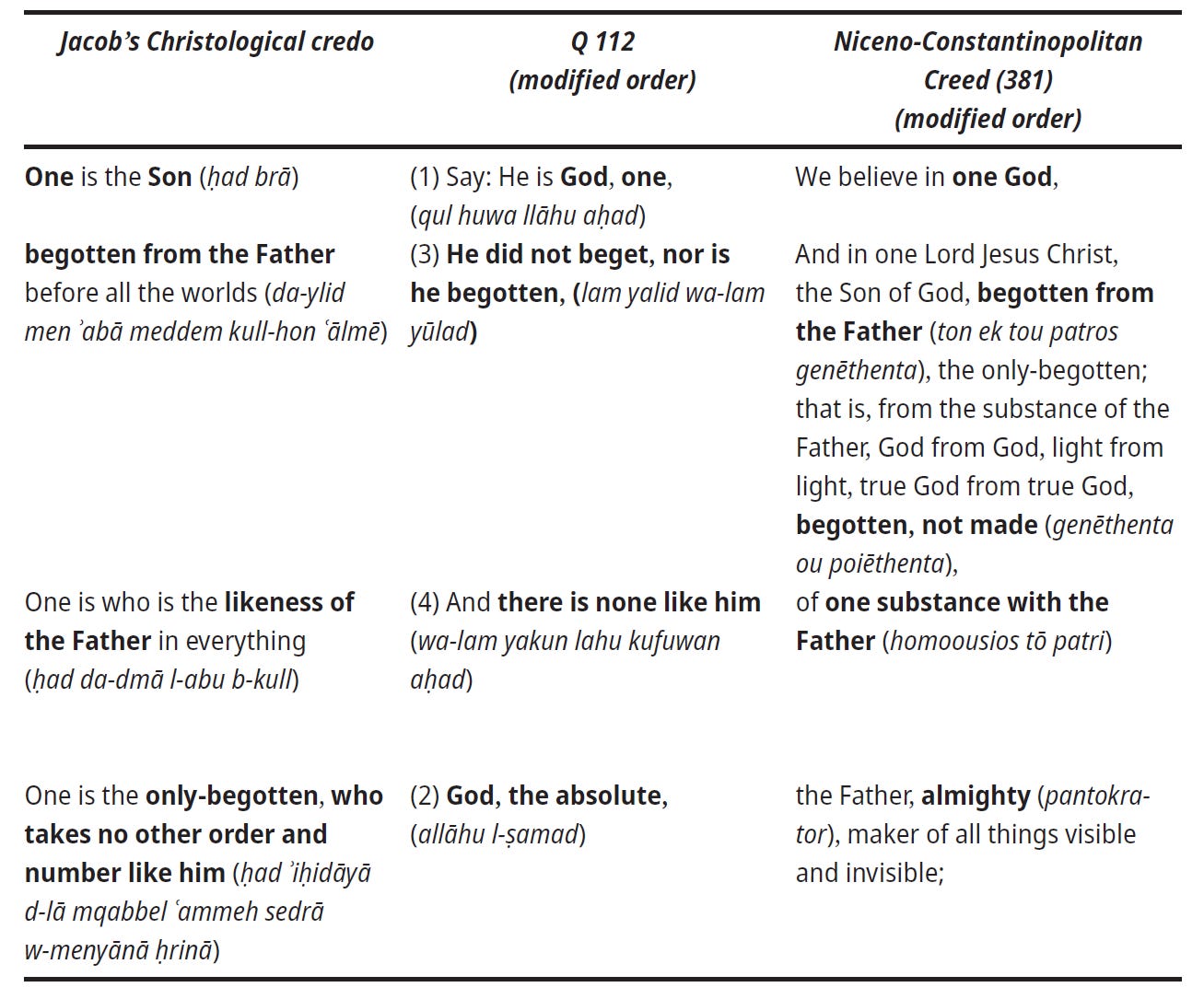
The Qur’anic phrase lam yalid wa-lam yūlad — “He neither begets nor is begotten” — is not merely a rejection of crude biological procreation. It also functions as an absolute and atemporal negation of divine begetting in the Christian creedal sense. In Syriac/Aramaic rendering of the Niceno-Constantinopolitan Creed, the cognate Semitic root y-l-d is used twice to describe the Son as “begotten” from the Father. The Creed in Syriac/Aramaic speaks of Christ as haw d-men Abo etheeled — “the one who was begotten from the Father” — and then confesses him as ileedo w-lo eʿbeedo — “begotten and not made.” Jacob of Serugh’s Christological credo (above) speaks of the Son as da-ylid men ʾabā, “begotten from the Father.” Narsai likewise speaks of God having an offspring who is da-ylid menneh, “begotten from Him” (Ghaffar, 2024, 17).
Arabic Christian renderings of the Niceno-Constantinopolitan Creed express the same doctrine with the Arabic root w-l-d, calling Christ al-mawlūd min al-Āb qabl kull al-duhūr — “begotten from the Father before all ages” — and mawlūd ghayr makhlūq, “begotten, not made.”
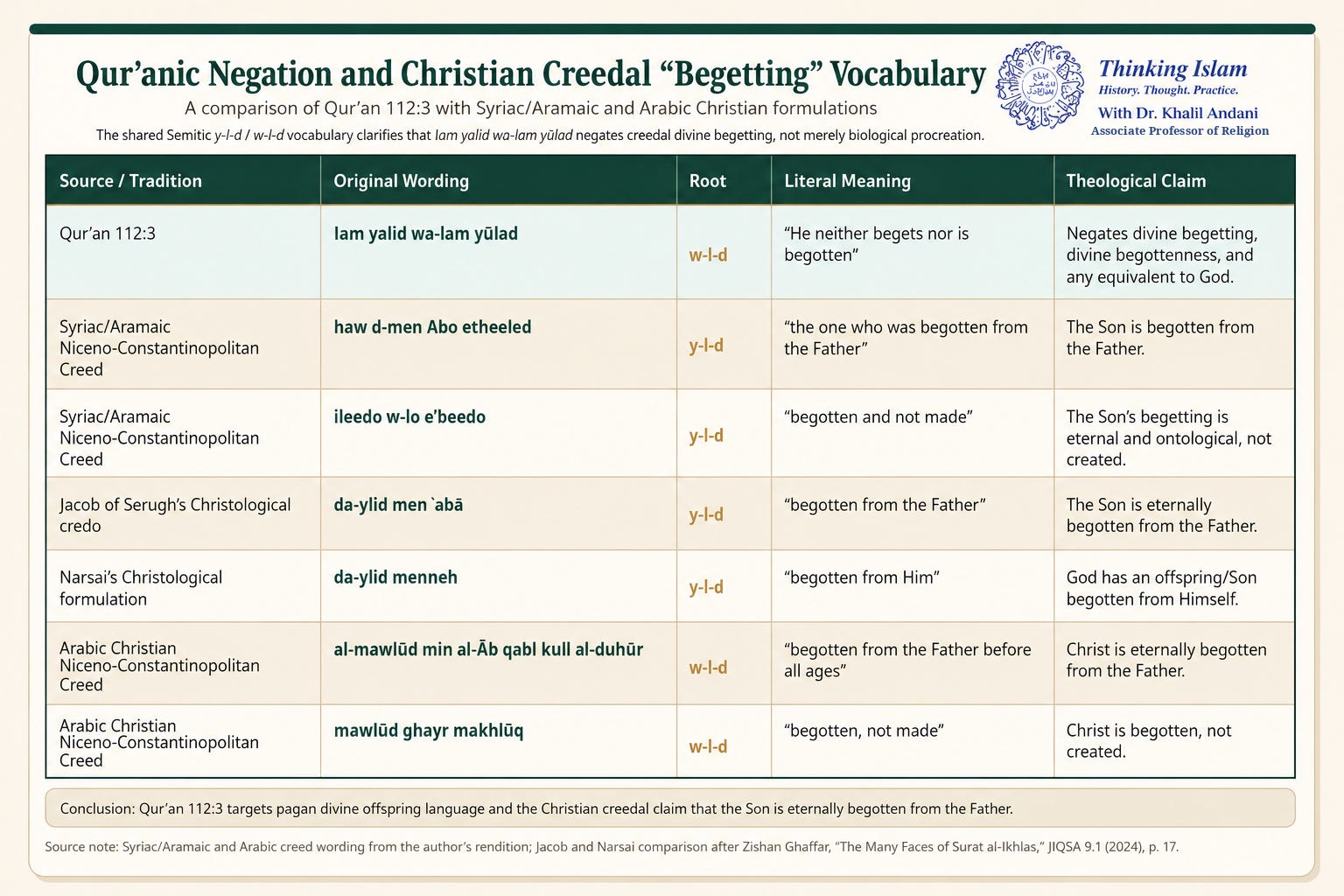
The Qur’an’s denial, lam yalid wa-lam yūlad, specifically targets not only pagan biological notions of divine offspring, but also the precise Christian theological vocabulary describing the Son as eternally begotten from the Father.
The Qur’an here is engaged in high-level theological discourse that rejects any Christian claims of ontological consubstantiality of God’s nature with any putative “Son of God” as well as any internal differentiation within God. Holger Zellentin concludes: “To the Jewish, Christian, and gentile denizens of Arabia, the Medinan Qur’ān thus presents a rejuvenated form of monotheism that dismisses the Nicene Creed, or a creedal confession very close to it, in a reformulation of the biblical Shema” (“The Rise of Monotheism in Arabia,” in A Companion to Religion in Late Antiquity, 157–180: 165).
God’s Loving Compassion: Qur’anic Rahma
Before delving into how classical Muslim scholars understood the Gospel’s terminology, it is vital to understand how the Qur’an itself frames God’s relationship with humanity. Every chapter of the Qur’an (save one) begins with the invocation of God’s two primary names of divine compassion: al-Rahman (The Lovingly Compassionate) and al-Rahim (The Especially Merciful).
Linguistically, both of these divine names are derived from the Arabic trilateral root r-h-m, from which we also get the Arabic word rahim, meaning “womb”. This etymological connection demonstrates that God’s rahma is nurturing, enveloping, and life-sustaining love—much like how the mother’s womb protects, nourishes, and encompasses the unborn child. Reza Shah-Kazemi, a scholar of the Qur’an and Islamic mysticism, explains as follows:
A compelling reason for translating Rahma as loving compassion and not just compassion—and certainly not just ‘mercy’—is provided by the Prophet’s use of this word in the following incident. At the conquest of Mecca, certain captives were brought to the Prophet. There was a woman among them, running frantically and calling for her baby; she found him, held him to her breast and fed him. The Prophet said to his companions: ‘Do you think this woman would cast her child into the fire?’ We said, ‘No, she could not do such a thing.’ He said, ‘God is more lovingly compassionate (arham) to His servants than is this woman to her child.’ The Rahma of God is here defined by reference to a quality which all can recognize as love: the mother’s acts of compassion and mercy stream forth from an overwhelming inner love for her child. One cannot love another without feeling compassionate to that person, while one can feel compassion for someone without necessarily loving that person. The Jewish scholar Ben-Shemesh goes so far as to translate the basmala as ‘In the Name of God, the Compassionate, the Beloved’ to bring home this key aspect of love proper to the root of Rahma. He argues that in both Arabic and Hebrew the meaning of love is strongly present in the root r-h-m, and gives the following evidence: Psalm number 18 contains the phrase: Erhamha Adonay—‘I love thee my Lord’. In Aramaic/Syriac, the root r-h-m specifically denotes love, rather than ‘compassion’. One can thus feel the resonance of this Syriac connotation within the Arabic Rahma. Moreover, there is epigraphic evidence that early Christian sects in southern Arabic used the name Rahmānan as a name of God, and this would probably have been understood as ‘The Loving’.
(Reza Shah-Kazemi, Common Ground between Islam and Buddhism. Fons Vitae, 2010, 94)
Understanding this foundational Islamic concept—that God’s overarching rahma is an unconditional, nurturing, and parental love—provides the perfect key to unlocking the Gospel metaphors. Much of what Jesus’ “Father” language expresses in the Gospel tradition — divine care, mercy, nearness, authority, and nurturing lordship — overlaps functionally with what the Qur’an expresses through rahma, rububiyya, and the divine names al-Rahman and al-Rahim.
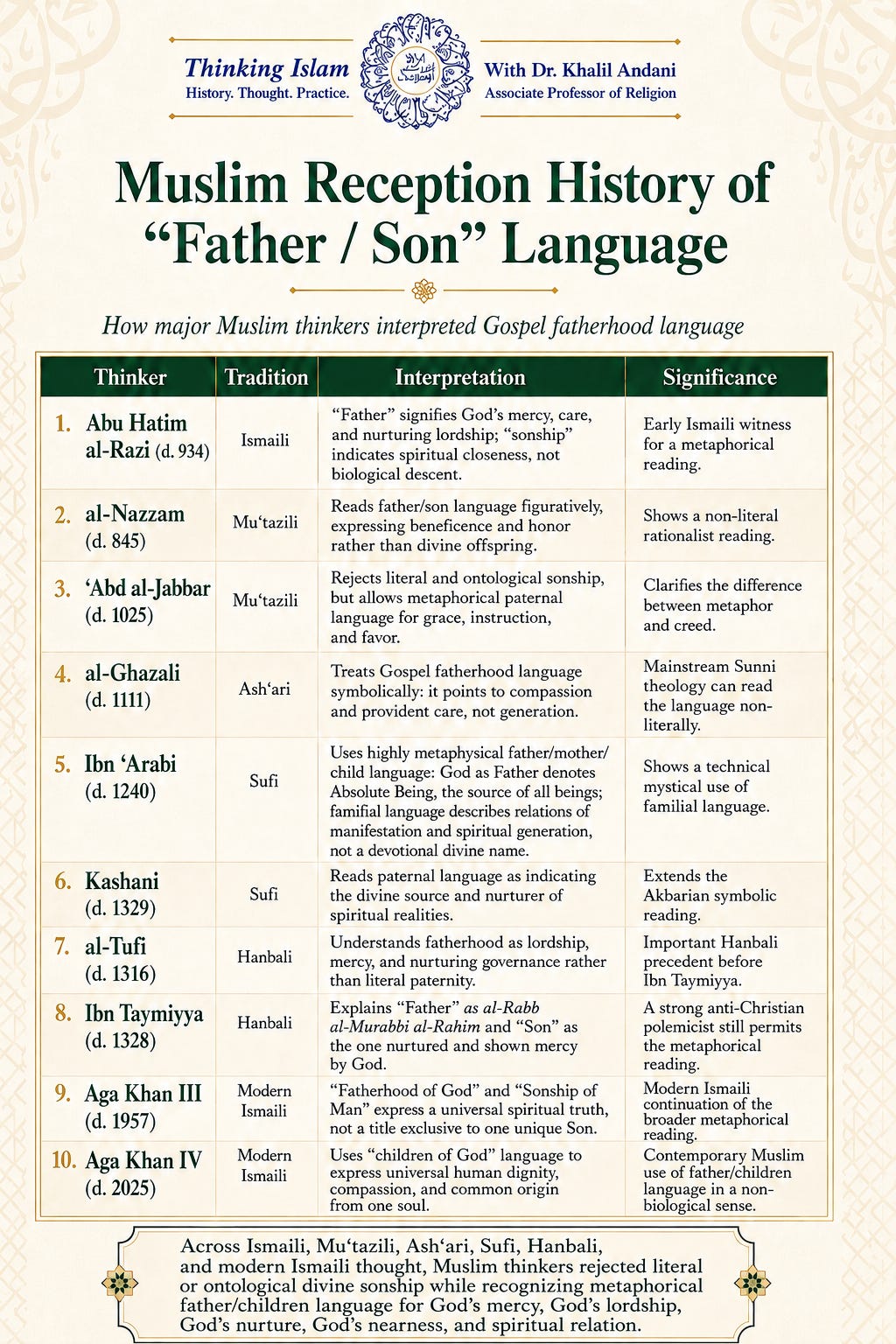
Reception History: Muslim Understandings of the “Father/Son” Language used by Jesus
What we have argued thus far is based on a critical historical reading of the Qur’an. Next, we can consider how post-Qur’anic Muslim scholars of various sectarian stripes understood the Qur’anic denial of God’s fatherhood. Did premodern Muslim scholars dismiss any and all senses of God’s fatherhood as idolatrous? Or were they also nuanced in their understandings of the fatherhood of God and the sonship of His creatures?
We find that across sectarian lines—spanning Sunni, Mu’tazili, Hanbali, Ismaili, and Sufi schools of thought—prominent Muslim thinkers concluded that the terms “Father” and “Son,” when stripped of later Trinitarian meanings and read in their original linguistic milieu, were entirely legitimate and profoundly expressive of the Islamic principles of God’s loving compassion (rahma), His nourishing lordship (rububiyya) and creaturely servitude (‘ubudiyya) before God. Some interpretations evoke the metaphysical notion of God as the Absolute Being who continuously existentiates all beings.
Below is a chronological sample of Muslim thinkers accepting various metaphorical senses of the “Fatherhood” of God and the “Sonship” of Jesus and humankind that do not conflict with the Qur’an or Islamic theologies.
Shi‘i Ismaili: Abu Hatim al-Razi (d. 934 CE)
The eminent Ismaili philosopher Abu Hatim al-Razi argued that the Christians had been led astray by faulty interpretation, taking a beautiful first-century simile and distorting it into literal procreation.
“In the Gospel, Christ said that he was the son of God, but he did not mean that he is His son through birth—far be it from God to take a wife and son—but, rather, he meant that Almighty God had elevated him, raised his status, and drawn him near and chose, selected, and loved him. In this he was coining a simile, as of a man who loves his son... Thus, Christ informed them that his nearness to God Almighty and his closeness to Him is similar to the closeness between father and son and that God loves him, is attached to him, and is merciful toward him, just like the love of a father for his son and his mercy and affection toward him. He informed them, too, in many places in the Gospel, that he is the special friend of God, which confirms what we have been arguing. He told his disciples, “You are the sons of God,” and meant the same thing-namely, that God had chosen them and selected them and was affectionate and merciful toward them.”
(Abu Hatim al-Razi, The Proofs of Prophecy. Translated by Tarif Khalidi. Brigham Young University Press, 2011, 118).
Mu‘tazilis: Ibrahim al-Nazzam (d. 840) and ‘Abd al-Jabbar (d. 1025 CE)
The Mu‘tazili theologian al-Nazzam interpreted the biblical “son of God” appellation as more or less equivalent to the Qur’anic designation of Abraham as the “friend of God” (khalil Allah):
“If God can take someone as a friend, then he can also take someone as a son. That is, if in this way he seeks to show how merciful and loving He is towards him.”
(Ibrahim al-Nazzam. In Gabriel Said Reynolds, A Muslim Theologian in a Sectarian Milieu. Brill, 2004, 33).
The Mu‘tazili Chief Judge and theologian ‘Abd al-Jabbar argued that the terms “father” and “son” as used by Jesus in the Gospels are acceptable and convey the meanings of “master, possessor, director” and “righteous servant, obedient, sincere friend” respectively.
“Some people have said that ‘son’ in the Hebrew language (which was the language of Christ) refers to a righteous servant, an obedient, sincere friend, while ‘father’ refers to a master, possessor and director… Therefore, according to the statement of the Christians, all of them should be gods and lords. Rather, know that the name “father” in that language refers to ‘master’ and ‘possessor’.”
(‘Abd al-Jabbar. In Gabriel Said Reynolds, A Muslim Theologian in a Sectarian Milieu. Brill, 2004, 99).
Sunni Ash‘ari: Abu Hamid al-Ghazali (d. 1111 CE)
In a major treatise refuting the ontological divinity of Jesus, the Sunni theologian al-Ghazali (or a prominent scholar from his immediate circle) explicated the father-son language of the Gospels as indicative of God’s relationship of kindness, compassion, and tenderness to His creatures and His prophets in particular. As he explained, the Prophets may be called “sons of God” in a metaphorical sense because they exemplify obedience to God’s commands akin to sons being faithful to their fathers.
“...a father is naturally disposed to being rich in compassion, kindness, mercy and tenderness to his son, eager to bring about in him all kinds of benefits, and to keep all kinds of evils from him... The role of son is to be respectful towards his father, to exalt him, to be very diffident before him, to obey his commands, to submit willingly to them with respect and honour; not contradicting them, but holding fast to what he commanded him to do and prohibited him from doing.
As for God, may he be exalted and glorified, if one were to measure his goodness to each prophet, his mercy to him... then what a father would do in relation to this would be trivial and insignificant. In addition, the respect of the prophets shown to God, their modesty before him, their obedience to his commands... are more profound than any good deed of sons towards their fathers. For he is to them a more merciful father and they are to him more devoted sons. This is the secret of the metaphor in such an application. When he (Jesus) employed a metaphor in applying ‘father’ to God, his meaning was that he is merciful and affectionate towards him, and when he employed a metaphor in applying ‘sonship’ to himself, his meaning was that he revered and glorified God.”
(Abu Hamid al-Ghazali, Abu Hamid [Attributed]. Al-Radd al-Jamil: A Fitting Refutation of the Divinity of Jesus. Edited and translated by Mark Beaumont and Maha El Kaisy-Friemuth. Brill, 2016, 155-157).
Sunni Sufi: Muhyiddin Ibn ‘Arabi (d. 1240 CE)
For the Sunni Andalusian mystic Ibn al-‘Arabi, God as the Absolute Being and source of all existence may be called the “First Father”. For Ibn ‘Arabi, the concept and name of “father” applies generally to anything that produces effects—including God and secondary causes such as the First Intellect and human spirits (arwah). Since God is the Absolute Being (wujud mutlaq) and the source of all things, God merits the name “First Father”. The first “mothers” refer to the eternal pre-creation state of contingent things within God’s Knowledge as immutable entities; each immutable entity is a “mother” that receives the existentiating command of God, the “father”, and this ontological “marriage” of God (“first father”) with each immutable entity (“first mother”) produces the “child”—the concrete creature. This ontological relationship is continuous and perpetual - meaning that God, as the source of being, is continuously engendering or “fathering” all existent things.
“Divine marriage takes place when God brings a thing into existence. He and the nonexistent thing are male and female, while the existent thing that results from the union is the child… God in Himself, nondelimited Being, is the father. Thus Ibn al-‘Arabi writes, “I have alluded to the all-pervading First Father: the all-comprehensive, greatest name that is followed by all the other names.” In other words, the First Father is Allah, which embraces all the other names and denotes the Real. The mother is the nonexistent things, while the creatures that enter into existence are the children. Fathers are “high” and mothers “low.” The “highness” of the father in this case is the fact that He is Being Itself, the source of all realities. The mother is “low” because she has no existence of her own. She is pure receptivity toward the perfections that the father sends down. Ibn al-’Arabi refers to the state of the things in God’s knowledge as their “thingness.” The term derives from various Koranic verses that refer to the “things” before God creates them, like the verse Ibn al-‘Arabi quotes in the following.
The first of the high fathers is manifestly clear. The first of the low mothers is the thingness of the nonexistent possible things. The first marriage is the intention of the command [given to the nonexistent thing, that is, “Be!”]. The first child is the existence of the entity of that thingness.
This father is all-pervasive in fatherness, this mother all-pervasive in motherness, and this marriage all-pervasive in all things. The result is continuous. It is never cut off for anything whose entity is manifest. This is what we call “The Marriage that Pervades all Atoms.” As evidence for what we said, God says, “Our only word to a thing, when We desire it, is to say to it ‘Be!’ and it is” [16:40].
(Sachiko Murata, The Tao of Islam: A Sourcebook on Gender Relationships in Islamic Thought. State University of New York Press, 1992, 148).
Sunni Sufi: ‘Abd al-Razzaq Kashani (d. 1329 CE)
Building upon Ibn ‘Arabi, the Sufi commentator Kashani explained that human parents—the father and mother—serve as the earthly mirrors or locus of manifestation of God’s “Fatherly/Motherly” attributes of lordship and existentiation. This is why the Qur’an commands goodness to parents immediately following the command to worship God. The engendering and nourishing roles of parents reflect God’s divine act of creating and sustaining existents:
“God places being good to parents next to Tawhid and considering Him alone as worthy of worship because parents correspond to the Divine Presence in the fact that they are the cause of your existence. And they correspond to the Presence of Lordship in the fact that they nurtured you when you were a helpless and weak infant, without power and motion. They were the first locus of manifestation within which such attributes of God as bringing into existence, lordship, mercy, and kindliness became manifest in relation to you.”
(‘Abd al-Razzaq Kashani. In Sachiko Murata, The Tao of Islam: A Sourcebook on Gender Relationships in Islamic Thought. State University of New York Press, 1992, 147).
Sunni Hanbali: Najm al-Din al-Tufi (d. 1316 CE)
Al-Tufi, a Hanbali jurist and student of Ibn Taymiyya, wrote a commentary on parts of the Bible including the four Gospels. Throughout this work (pp. 127-129; 151 165, 173 282, 197, 209, 377, 399-401), al-Tufi interprets the fatherhood of God and sonship of Jesus as a metaphor for God’s nurturing lordship and care over His servant, Jesus, and creation in general:
“The guiding principle when giving a metaphorical interpretation is the fact that a shared value exists between being a ‘lord’ and being a ‘father’; that is to say, the lord’s mercy for his servant and the father’s mercy for his child. Similarly, a shared value exists between being a son and being a servant, namely, the servant’s deep respect for his master and the son’s deep respect for his father.” (p. 127)
“We have already explained that the metaphorical usage here concerns the expression ‘the son’ and that it means ‘the servant’ or ‘the messenger’, because a son obeys his father with the same obedience with which a servant obeys his master, and a father, according to custom, sends his son for his needs just as a ruler and others would send their messenger.” (p. 173)
(Najm al-Din al-Tufi. In Demiri, Lejla, Muslim Exegesis of the Bible in Medieval Islam: Najm al-Din al-Tufi’s Commentary on the Christian Scriptures. Brill, 2013, 127, 173).
Sunni Hanbali: Taqi al-Din Ibn Taymiyya (d. 1328 CE)
Even Ibn Taymiyya, famously stringent in his theological boundaries, recognized the theological validity of Jesus using father/son vocabulary to describe his relationship with God. He famously linked the biblical language of fatherhood to the Islamic belief that God’s nurturing care and loving compassion far exceeds even a mother’s love.
“If this phrase is authentically attributed to the infallible Christ, peace and blessings be upon him, then he intended by it that which aligns with the rest of his discourse. In what is found within their books, the Lord is referred to as a Father and His servants are referred to as sons. For instance, they mention that He said in the Torah to Jacob, ‘Israel, you are My firstborn son,’ and He said to David in the Psalms, ‘You are My son and My beloved.’ Furthermore, in multiple places in the Gospel, Christ says, ‘My Father and your Father,’ such as his saying: ‘I am going to my Father and your Father, to my God and your God.’ Thus, he names Him as a Father to them just as he names them sons for Him. If this is true, then the intended meaning [of ‘Father’] is the Nurturing, Loving and Compassionate Lord (al-Rabb al-Murabbi al-Rahim), for God is more lovingly compassionate to His servants than a mother is to her child, and the ‘son’ is the nurtured one who is shown loving compassion (al-murabba al-marhum). Indeed, God’s nurturing of His servant is more complete and perfect than a mother’s nurturing of her child. Therefore, the intended meaning of the ‘Father’ is the Nurturing Lord (rabb), and the intended meaning of the ‘Son’ in this context is Christ, whom He nurtured.”
(Ibn Taymiyya, al-Jawab al-Sahih li-man baddala din al-Masih. Volume 3, 193-194, 2nd Ed., Dar al- ‘Asima, 1999)
Modern Ismaili Expressions of God’s Fatherhood: Aga Khan III and Aga Khan IV
The same metaphorical understanding of father/son language for God and humanity appears in modern Ismaili thought in the public discourses of the forty-eighth and forty-ninth hereditary Imams of the Ismaili Muslims - Sir Sultan Muhammad Shah Aga Khan III (d. 1957) and Shah Karim al-Husayni Aga Khan IV (d. 2025).
Aga Khan III critiqued the Christian theology of divine sonship by saying: “We think that we are the true Christians, and that your Church distorted the message. We think that the Fatherhood of God and the Sonship of Man has no particular and special application to the One Son of Man” (“Is Religion Something Special?” The Daily Sketch Interview).
Aga Khan IV expressed the same universal idea in his public speeches. He cited the Qur’anic teaching (4:1) that God created all human beings from a single soul and remarked that: “These words reflect a deeply spiritual insight - A Divine imperative if you will - which, in my view, should undergird our educational commitments. It is because we see humankind, despite our differences, as children of God and born from one soul, that we insist on reaching beyond traditional boundaries as we deliberate, communicate, and educate internationally” (Speech by His Highness the Aga Khan at the annual meeting of the International Baccalaureate, 18 April 2008).
Conclusion
The claim that the historical Jesus’ use of “Father/Son” language makes the historical Jesus incompatible with Islamic belief does not hold up to scrutiny. The Qur’an rejects God being a “father” in the specific senses of a) God producing biological offspring; b) Jewish and Christian communal claims to being privileged children of God; c) the Christian Trinitarian theology of Jesus being the consubstantial son of God. However, it does not follow that all meanings of Father/Son language found in Abrahamic religious discourses are rejected by the Qur’an.
This interpretation of the Qur’an is confirmed by the reception history of the Qur’an among diverse Islamic communities of interpretation. Premodern Muslim scholars across a remarkable range of sectarian affiliations (Ismaili, Mu‘tazili, Ash‘ari, Sufi, Hanbali) recognized the nuances involved in different meanings of God being a father and Jesus being God’s son. They interpreted the Gospel’s father/son language as signifying God’s loving compassion, mercy, lordship, nurturing care, intimate nearness to His prophets, and the Prophets’ reverent obedience to God. On their reading, Jesus’ address to God as “Father” does not contradict his status in the Qur’an as one who surrenders to God. But rather, Jesus’ invocation of God as our Father reveals, in first-century Jewish idiom, what Qur’anic and Islamic theology describe as God’s rahma (loving compassion) and rububiyya (nurturing care); the all-loving and compassionate Creator who continuously sustains and nurtures His servants.
What an absolutely beautiful article.
Thanks so much for sharing, Dr. Khalil.
Good read, thank you